Monday, October 1, 2018

American Flat Remembered At October 6 Film, Photo Show and Lecture

Silver City, Nevada - There will be a free event called “Remembering American Flat” this Saturday on the Comstock. The event includes three parts – a screening of a new documentary that covers the history of the American Flat mill from its inception in the 1920s to its demolition in 2014; a short lecture about the unique qualities of the mill by consulting architectural historian and industrial archaeologist Ron Reno, PhD; and a pop-up show with locals’ rare photos of the site.

The United Comstock Merger cyanide mill at American Flat was the largest of its kind during its operation. After being abandoned in 1926 due to the collapse in the price of silver, the unusual architecture of the remaining ruins became an attraction. Over the decades, the site drew artists, photographers, film-makers, paintballers and others who re-imagined the industrial ruin as a a place of unusual beauty and freedom.
PHOTO BY JACK FREER

The public is cordially invited to the free event which will be held on Saturday, October 6 at 1pm at the Silver City School House (community center) at 385 High Street in Silver City, Nevada 89428. Silver City is located within a national historic landmark three miles from Virginia City, 12 miles from Carson City and 29 miles from Reno.

“Remembering American Flat” is sponsored by the Silver City Arts group in partnership with the Bureau of Land Management (Carson City District) and the Silver City Volunteer Library.

For more information, contact Quest Lakes at (775) 847-0742.

The Silver City Arts group is composed of volunteers whose mission is "to encourage the arts, build community, and share our unique town through free, public events.” The group draws on the town’s own wealth of resources for programming, and also connects with other groups to bring public programming from well known artists, writers, musicians, etc. to the community. Silver City has been declared an "Arts and Culture Resources Production Center" due to its support for arts and culture, and for its own residents’ high output of art, music, publications, and historic preservation resources over the last 50 years.

Longtime Silver City denizen Ron Reno, PhD, an Industrial Archaeologist and Architectural Historian, is among those interviewed in the film The American Flat Mill: Icon of the Comstock

The BLM manages more than 245 million acres of public land located primarily in 12 Western states. The agency's mission is to sustain the health, diversity, and productivity of America's public lands for the use and enjoyment of present and future generations. Diverse activities authorized on these lands generated $96 billion in sales of goods and services throughout the American economy in fiscal year 2017. These activities supported more than 468,000 jobs.

Sunday, September 30, 2018

American Flat Reinterpreted


One of the first uniquely Comstock things my husband took me to see after we met was American Flat and the United Comstock Merger mill site - it had been abandoned in 1926 due to the collapse in the price of silver. We hopped on his three wheeler and took a low speed, leisurely ride to the historic spot, which was beautiful in a bizarre and wabi sabi sort of way. We were sad to see it demolished a few years ago, but glad that Bureau of Land Management (BLM) preserved some of the local memories and historic photos and facts about the place in a documentary.

In the film, Dr. Ron Reno of Silver City, an industrial archaeologist and architectural historian, explains, "The American Flat Mill is one of the touchstones for people that live up here on the Comstock. It's someplace everyone ends up going to repeatedly, and everyone is drawn to it. There's nothing like it anywhere in the region and it has a sort of aesthetic effect that is very powerful. And you can see anything from just local teenagers to professional photographers and artists that keep coming out here and being drawn to the Flats."

He’s right. Over the years, my husband and I took a number of visiting family and friends to see the ever-changing artwork at the site.

Internationally acclaimed artists such as New Zealand born photographer Frances Melhop have staged photos there, most notably her striking photograph of New York City’s American Modern Ensemble.

Gary Short, and award-winning poet who lived at American Flat for several years, wrote a poem called “American Flat” which includes the lines, “under the high hunger of the hawks,/I’ve been walking in Nevada./ In the Republic of sage where/shoe leather and femur of cows endure.”

Foundation Professor of Arts at UNR, Peter Goin, is also interviewed in the film. He notes, "When I look at American Flat, this is something new, this is something different.This is something where mining landscapes have been appropriated and incorporated, reinterpreted. They become alive. The landscape now has its own ongoing historical narrative. And its unpredictable. It's engaging. And its very dynamic..."

Goin is onto something. Virginia City’s tourism industry offers a version of history tailored for out-of -town tourists, but places like American Flat offered a glimpse of authentic Comstock history, and showed how more recent residents of the Comstock re-imagined the ruins as a place of unusual beauty and freedom.

This Saturday, October 6th at 1pm at the Silver City School House (385 High Street, zip 89428), the public is cordially invited to a free screening of the BLM’s film and a one day pop-up show featuring locals’ photos of the historic site. Alicia Jensen of the Bureau of Land Management will introduce the film and describe efforts to preserve the history of the site. The film will be followed by a lecture about the architecture and unique features of the mill site by consulting architectural historian and industrial archaeologist Ron Reno, PhD. The event is co-sponsored through Silver City Arts group, Bureau of Land Management and the Silver City Volunteer Library. Light refreshements will be available.

For more information, contact Quest Lakes at 847-0742.

Thursday, August 16, 2018

Absence of Local Newspapers Equals Higher Taxes

I watched a fascinating documentary this week called All the Queen’s Horses. It’s about Rita Crundwell, who was able to embezzle more than $53 million dollars while she was comptroller and treasurer of the small town of Dixon, Illinois between 1983 and 2012. During those years, she stole about $2.5 million per year from the city of about 15,000 people. She concealed her crimes partly by claiming budget shortfalls were due to the state being late in paying the city its share of tax revenue. As a result of her fraud, city departments had to make extreme cuts to public services, and employees went years without raises. Dixon’s police went without essential equipment like radios and few of the town’s streets were repaired.

Dixon had a local paper called the Dixon Evening Telegraph that operated from 1886 until 2008. After 2008, the townsfolk got their news from a large news company covering 24 cities in the region, and Rita Crundwell began embezzling even more money.

Watching the documentary reminded me of a new study I’d seen showing that when local newspapers close, the result is higher costs for taxpayers.

Researchers from the University of Illinois and the University of Notre Dame, who conducted the study, explained that this happens because one of the roles of small town newspapers includes being “watchdogs of local government.” This role keeps local governments on their toes and increases efficiency.

So exactly how does the lack of a local newspaper translate into higher taxes? Lenders to municipal governments understand the role of newspapers with regard to local government efficiency. If they see that a town has no local newspaper, they consider this weakness and tend to ask for higher interest rate when lending for things like public buildings, roads, schools, etc.

The study, “Financing Dies in Darkness? The Impact of Newspaper Closures on Public Finance,” found that municipal borrowing costs increase by 5 to 11 basis points in the first few years after a local newspaper closed its doors. This means taxes go up roughly $70 for the average taxpayer, according to the study.

I’m not making a case against taxes here – public buildings, roads, parks, schools, etc are wonderful and essential and I am happy to pay taxes for them. My point is that local newspapers are an important part of making sure our taxes are used in the most effective ways possible to secure the public goods our communities need to thrive.

Side Note: In 1876, the Lyon County Times newspaper was being published in Silver City, Nevada as a daily. It was reduced to a tri-weekly publication after three months, and to a semi-weekly by 1877. The paper was sold in 1878, and sold again shortly after. Finally, in 1880 the newspaper owner, John M. Campbell, moved the press to Dayton, Nevada where he continued the Lyon County Times as a four-page Republican weekly. Fred W. Fairbanks joined Campbell as a partner in 1883 and took over as sole owner and editor in 1885. Fairbanks continued publishing the newspaper in Dayton until 1901 when he moved the paper to Yerington. Fairbanks remained the editor until he sold the paper in 1907 to R. Leslie Smith who changed its name to the Yerington Times. That paper passed through a number of owners until J.A. McCarthy bought it in 1919. The paper finally stopped publishing in 1932.

*First published as a column in MVN by Quest Lakes in Aug. 2018

Photo by journalist Peter Krogh Andersen of Denmark

2018 Photos - Silver City's Summer Fun for Adults and Kids

Silver City - Throughout the year, Silver City's many groups and volunteers help bring public programming in art, music, history, science and more to the local park, outdoor stage and School House, with something to appeal to every age group, from toddlers to elders. And the community really puts in the extra effort during the summer. Scroll through the photos below to see summer fun in Silver City 2018.

Sean Laughlin offered a well-attended Thai cooking class at the School House in June.


About 2 dozen kids and their parents attended the annual engineering mini-camp at the Silver City School House again this summer. The camp was led by the Society of Women Engineers, FLL Team VC Silver Bricks, FTC team Cyber Mafia, and F.I.R.S.T. (For Inspiration and Recognition of Science and Technology). This year, the camp focus was on coding robots to move, with competition among each team's robots.

Cortney Bloomer of Healthy Communities led the annual Bicycle Safety Rodeo for ages 5-12 on the Silver City basketball court again this summer.

Jim Barcellos of University Nevada Cooperative Extension (UNCE) taught his annual interactive science classes at the School House again this summer.

The Silver City Volunteer Library had lots of visitors this summer.


Thanks to Robert Elston, PhD for the May- June display at the local post office titled Progress in a Multi-year Archaeological Project. Dr. Elston was among those awarded a National Science Foundation award for the Grass Valley project.

United Way of Northern Nevada and the Sierra hosted their annual pre-K fun fair for preschoolers and their parents this summer.


Professional floral designer Lynnette Edmondson offered a free floral design class for adults at the School House this summer.

Mylo McCormick offered a free concert in the park this summer.


Lisa Godenick offered a free somatics workshop for adults at the School House.

The Society of Women Engineers, FLL Team VC Silver Bricks, FTC team Cyber Mafia, and F.I.R.S.T. (For Inspiration and Recognition of Science and Technology) offered their annual engineering mini-camp again this summer, with a focus on coding robots to move.


Friday, August 10, 2018

Free Engineering Mini-Camp in Silver City Tuesday August 14th

Silver City, Nevada - Boys and girls ages 7-13 will build and code robots to move during an annual engineering mini-camp in Silver City on Tuesday, August 14 from 10am-noon.

The free activity will be led by the Society of Women Engineers’ Sierra Nevada section, in partnership with FLL Team VC Silver Bricks and FTC team Cyber Mafia.

About the Silver City Summer Program: Each summer, the historic Comstock community of Silver City partners with local and regional groups and community volunteers to offer public programming in science, technology, engineering, arts and math (STEAM), with events at the town’s park and community center. The engineering mini-camp is sponsored in partnership with Healthy Communities Coalition of Lyon and Storey Counties.

Location: The Silver City School House (community center) is located at 385 High Street, Silver City, Nevada. The historic town is on located within a national historic landmark 3 miles from Virginia City, 7 miles from Dayton, and 12 miles from Carson City.

For more information about the annual summer program and additional upcoming events, contact Quest Lakes at (775) 287-7598.
Engineering 2017


Engineering 2016


Engineering 2015


Monday, August 6, 2018

Free Gentle Movement Class at the Silver City School House Aug 7th

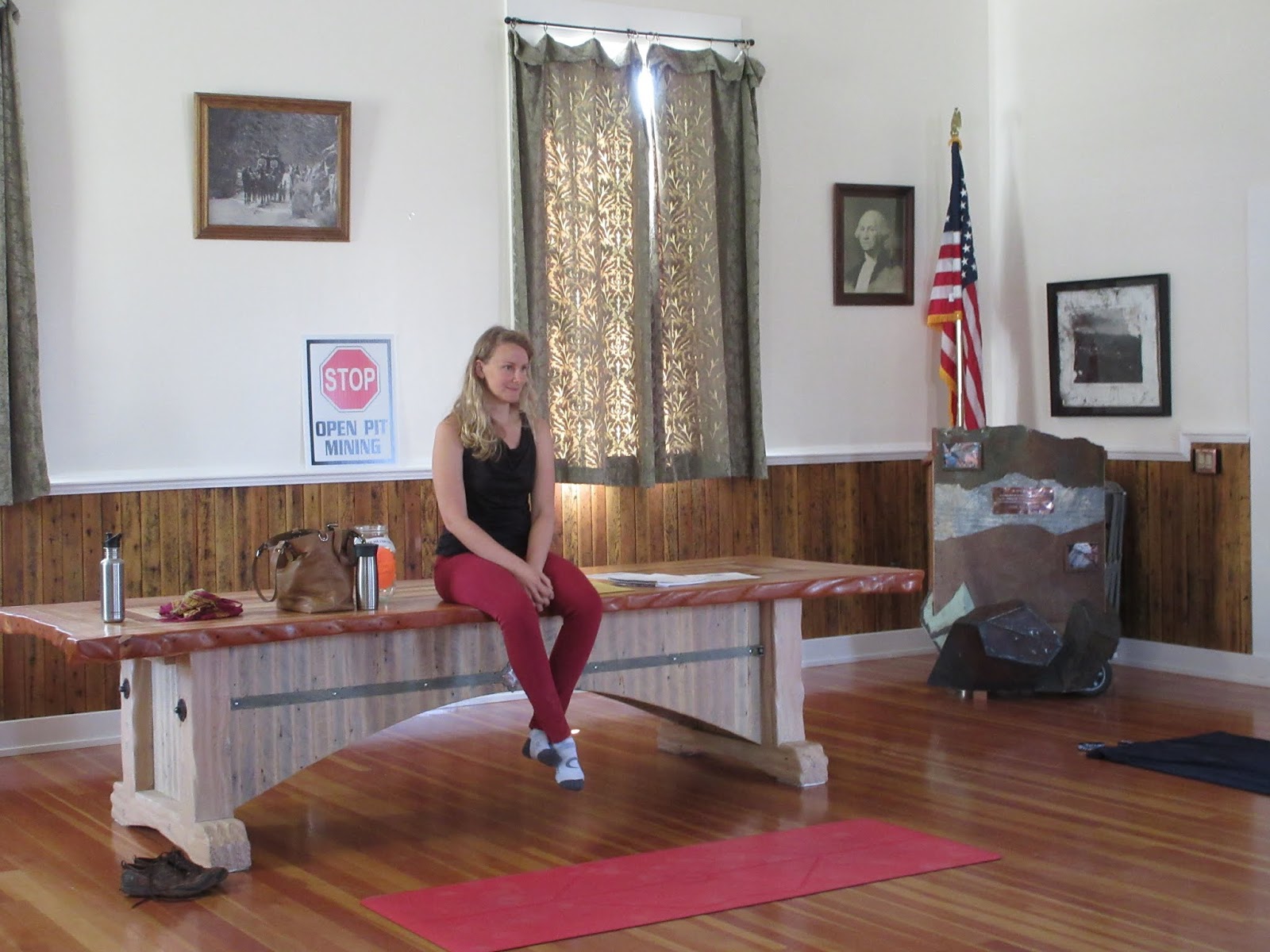
Silver City, Nevada – A free Clinical Somatics class for adults will be offered at the Silver City School House at 385 High Street on Tuesday, August 7th, 2018 from 10am-11am.

Clinical Somatics engages the nervous system in an active learning process that consists of very slow, focused, conscious movements. The movement techniques used in Clinical Somatics teach the nervous system how to release chronic muscle tension and stand and move in natural, efficient ways.

Somatic movements are very gentle, and not forced. The class will begin with standing and walking awareness, then move to the floor. For most of the class, participants will be in a relaxing comfortable position, lying on their backs, with knees upward, feet planted behind sitting bones.

Lisa Godenick of Healthy Communities Coalition of Lyon and Storey Counties, who will teach the class, explains that she “always tells clients to do the movements to their peaceful end point – rather than going into stretching or strengthening mode. If the position is not comfortable, we will adjust as need be. I am excited to share and help people move towards freedom and away from pain and tension.”

Participants should bring a yoga mat or large towel.

Please RSVP to quest@theodata.com.

About the Instructor: Healthy Communities’ Programs Coordinator, Lisa Godenick, has a Master’s degree in Public Health and works with Healthy Communities’ school-based Resource Coordinators throughout Lyon County School District. With a background in teaching yoga, she’s very interested in the mind-body connection. She practiced at her local yoga studio in South Carolina throughout her college years. Then in 2012, she completed a 200-hour Yoga Teacher Training in India. Today she also serves on the Board of Directors of Urban Lotus, a Reno nonprofit whose mission is “to serve and empower at-risk and underserved youth and young adults through trauma-informed yoga and meditation practices.”

Where is Silver City? Events like this one are opportunities to discover Silver City, one of the hidden gems of the Comstock. Silver City is located within a federally designated historic landmark, 3 miles from Virginia City, 7 miles from Dayton, and 12 miles from Carson City. Throughout the year, the town's many groups help bring public programming in art, music, history, science and more to the local park, outdoor stage and community center (School House), with something to appeal to every age group, from toddlers to elders.

Thursday, July 26, 2018

Silver City: This Town is Forever

Silver City, Nevada - This year, Lyon County (as a community and region) was named among the top ten in the national Robert Wood Johnson Foundation Culture of Health Prize competition. Last week a team with members from five different states and four different health policy organizations visited the Lyon County community to help RWJF understand the region’s unique cross-sector work to give all residents opportunities to lead their healthiest lives. If the Lyon County region is designated a Culture of Health Community - a national designation - there will be a ceremony at Princeton and extensive publicity through film, press releases, etc. Winners will be announced in October of 2018.

The team had time for a three hour tour of several initiatives that showed some of the Lyon County community’s work to become a “culture of health.” After the tour, they met in Dayton with twenty selected community members from throughout the region to attend a dinner discussion on the topic.

The next morning, the team met with several of the Lyon County area's denizens to discuss how Lyon County, as a community, is using cross-sector collaboration and commonly held goals and strategy plans to increase opportunities for health and wellness. Those attending the breakfast meeting included Lyon School Superintendent Wayne Workman; Lyon County Human Services Director Edrie LaVoie; Healthy Communities Coalition of Lyon and Storey Counties Director Wendy Madson; Lyon Juvenile Probation Chief Eric Smith; and Turning Point, Inc Director Deborah Loesch Griffin. I also attended as the Resident Artist Program in Silver City Director and organizer for Silver City’s annual children’s arts and science program.

I was delighted that the morning discussion was held on the Comstock at the lovely Silver City School House/community center. As the team and community leaders gathered for the early morning discussion, they asked questions about the tiny but mighty mountain town and its commitment to a healthy environment.

I explained that although this Lyon County town has its roots in underground mining in the 1800s, over the last fifty years locals have leveraged the town’s social capital and collaborated with regional, state and national groups to create a very different focus.

We Silver City folks take great pains to preserve our rich history, which began with gold rush mining of the 1800s. For instance in 2007, the Nevada State Historic Preservation Office officially recognized Ron Reno and the Town of Silver City “for a remarkable effort, donated to excavate and document the Old School House.” In May, 2008, the Board of Lyon County Commissioners passed a resolution congratulating the citizens and community of Silver City’s “contribution towards the quality of life in the community through the completion of the Schoolhouse and subsequent dedication of the State Historical Marker 264.”

Although we’re careful to preserve our town’s history, we also understand that early mining operations caused environmental contamination. Over the last fifty years, the townspeople have worked hard to transform the town.

Part of that fifty year transformation involved making sure that the County’s land use zoning reflected the town’s modern manifestation as a residential community rather than as an industrial site.

In 1986, the American Planning Association gave the Silver City Residents Association its Outstanding Citizen Contribution to Planning in Nevada award for its successful opposition to Nevex Gold Company’s open pit mine proposal. In that year and for many years before and afterward, Lyon County Commissioners agreed that the town was not to be used for open pit mining. With continual civic involvement from the folks of the town, the County Commissioners affirmed through Master Plans of the 1970s, 1980s and 2010 that Silver City was zoned as a residential community rather than as a spot for heavy industrial use such as modern pit mining.

But in 2014 a new set of Commissioners made a radical departure from the common sense of the last fifty years on this issue.

Silver City continues to strive to be a "community of health" even as it faces a whole group of Goliaths who are hostile to that goal. The town has continued to oppose open pit mining in and adjacent to the townsite where drilling, blasting, exploration and pit mining disturbs and distributes contaminated material from 19th century mining operations. Residents continue to preserve the things that make the town worth fighting for, cultivating an organic community garden, organizing monthly community dinners, celebrating outdoor activity (a local women's hiking club was featured recently by the Nevada Conservation League through photos), and hosting public programming in music, art, science and more at the town's outdoor performance stage, community center and park.


*First published as a column by Quest Lakes in the MVN in June 2018.